

 Unimak Technologies
 06 March 2026
 UberEats Clone App
UberEats Clone App - The Fastest Way to Build and Scale Your On-Demand Food Delivery Marketplace
The global food delivery industry has experienced massive growth in recent years, driven by changing consumer lifestyles and the increasing demand for convenience. Platforms like Uber Eats have revolutionized the way people order food, connecting restaurants, delivery drivers, and customers through a seamless digital ecosystem. For entrepreneurs and startups looking to enter this booming industry, developing a food delivery app from scratch can be expensive and time-consuming. This is where an UberEats Clone becomes a powerful solution. With ready-made architecture, proven features, and scalable technology, businesses can launch their own on-demand food delivery marketplace quickly and efficiently.
Understanding the UberEats Clone App Model
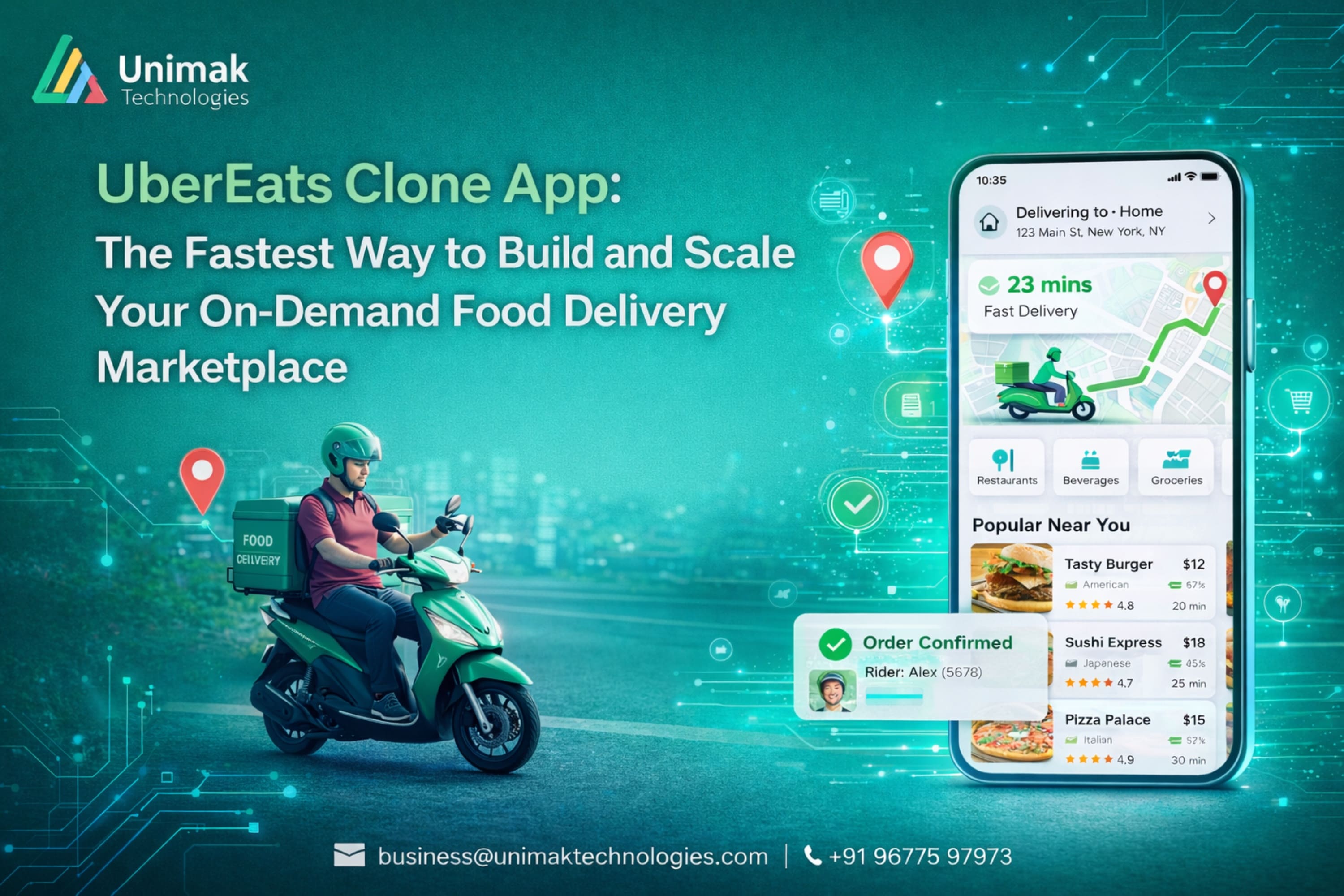
An UberEats clone app is a ready-to-launch software solution that replicates the core functionality of successful food delivery platforms. It enables businesses to build a multi-restaurant marketplace where users can browse restaurants, place orders, and get food delivered to their doorstep.
The ecosystem usually consists of three main applications:
-
Customer App – Allows users to explore restaurants, place orders, track delivery, and make payments.
-
Restaurant Panel – Helps restaurants manage menus, orders, and delivery requests.
-
Delivery Partner App – Enables drivers to accept orders and deliver food efficiently.
-
Admin Dashboard – Gives the business owner full control over the entire platform.
This integrated system creates a smooth operational workflow for the entire food delivery network.
Key Features of a Powerful UberEats Clone App
To compete in the on-demand food delivery industry, a platform must deliver a smooth and reliable user experience. A feature-rich UberEats clone typically includes:
How an UberEats Clone Helps You Scale Faster
Launching a food delivery marketplace requires both technology and operational efficiency. A scalable UberEats clone helps businesses grow faster by offering:
-
A ready-to-deploy infrastructure
-
Flexible customization options
-
Advanced analytics and reporting
-
Multi-city expansion capabilities
With these tools, startups can expand their platform across different locations and onboard more restaurants without rebuilding their technology.
The Future of On-Demand Food Delivery Platforms
The demand for online food delivery continues to rise as consumers prioritize convenience and speed. Emerging technologies like AI-based recommendations, smart route optimization, and automated delivery systems are further transforming the industry. Businesses that adopt advanced food delivery solutions today will be well-positioned to lead the next generation of digital marketplaces.
Final Thoughts
The success of platforms like Uber Eats proves that on-demand food delivery is not just a trend it’s a long-term opportunity for entrepreneurs and startups. By leveraging a powerful UberEats clone, businesses can quickly launch their own marketplace, connect restaurants with customers, and scale their operations efficiently. With the right strategy and technology, your food delivery platform can become the next big player in the on-demand economy.